A surprising wetland comeback
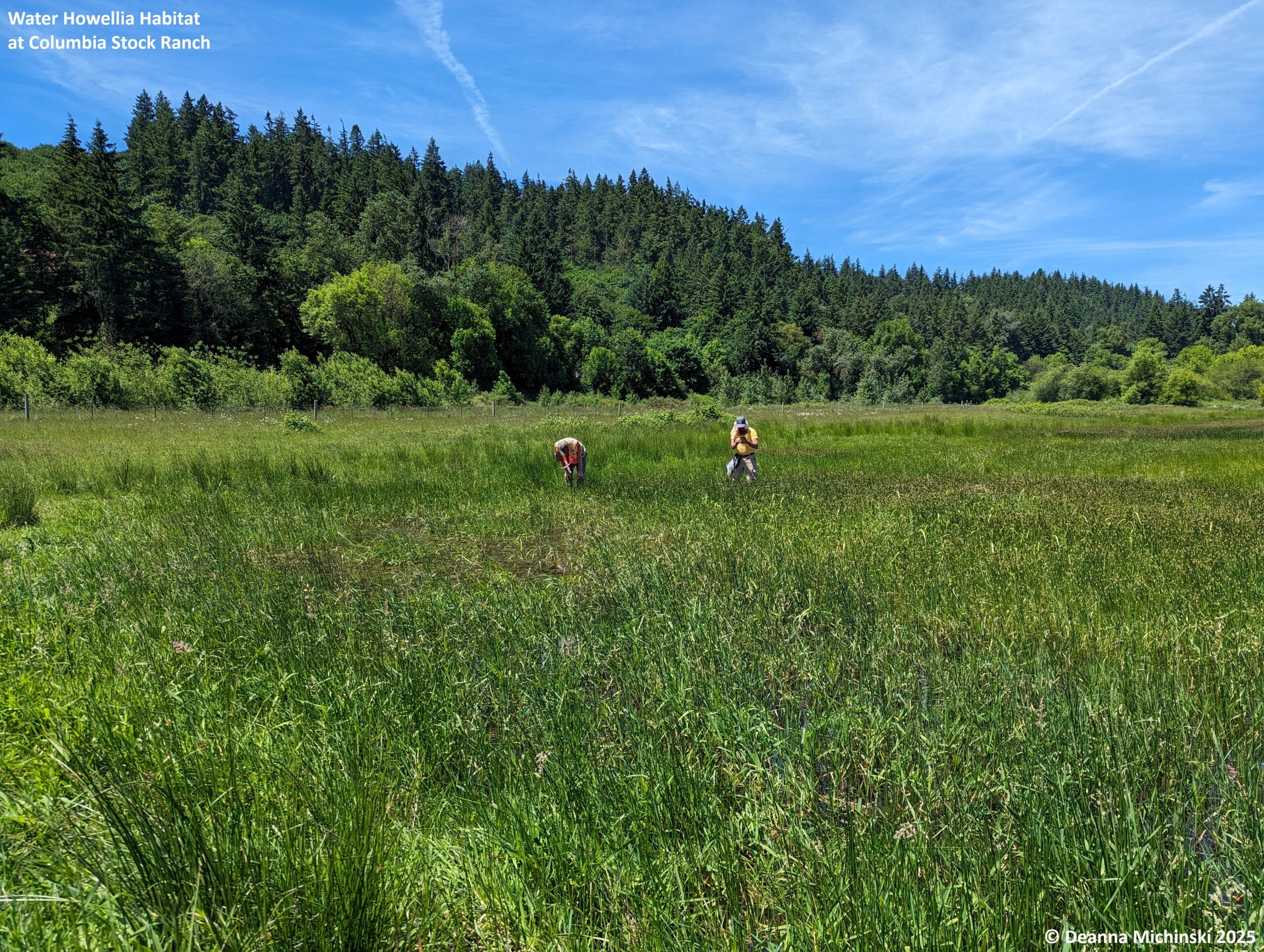
2025 was an exciting year at Columbia Stock Ranch, a 900-acre site in Columbia County, Oregon. Thanks to financial support from the Coalition of Oregon Land Trusts, we conducted a complete botanical inventory of a large portion of the property that tallied 259 species of vascular plants. The survey led to the surprising discovery of a robust population of Water Howellia (Howellia aquatilis). This rare species was once thought to be extirpated from Oregon, and the discovery was even more surprising given that the plant was growing in a minor, disturbed swale.
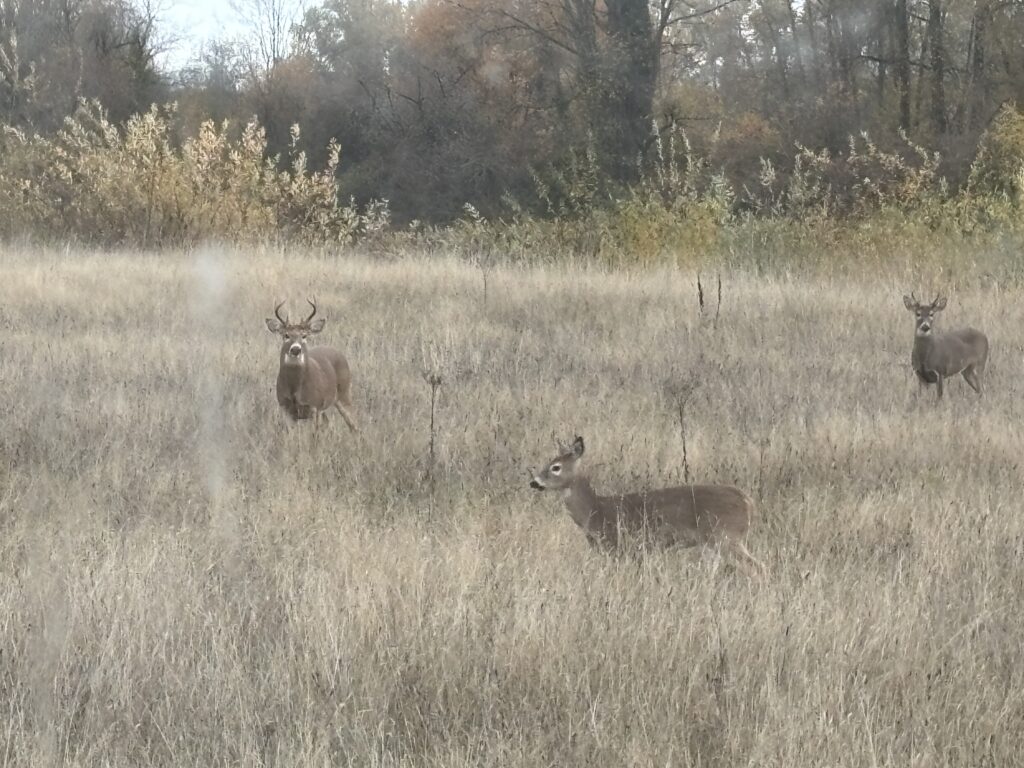
Much of Columbia Stock Ranch is located within the Columbia River floodplain. Prior to being conserved by the Land Trust, it was diked and used as cattle pasture and hay fields. Over the last 12 years it has been grazed seasonally as a temporary strategy to manage vegetation while restoring habitat for Columbian white-tailed deer.
Jason Clinch of Three Creeks Consulting led the botanical survey team, which included expert volunteers Rick Shory and Deanna Michinski (who was the first to find the Water Howellia).“I remember getting a call from Jason, he was nearly speechless with excitement,” recalled Land Trust Natural Area Manager Austin Tomlinson. “I’m not surprised a rare plant like Water Howellia was found at Columbia Stock Ranch, it’s a really special place!”
The Discovery
by Jason Clinch
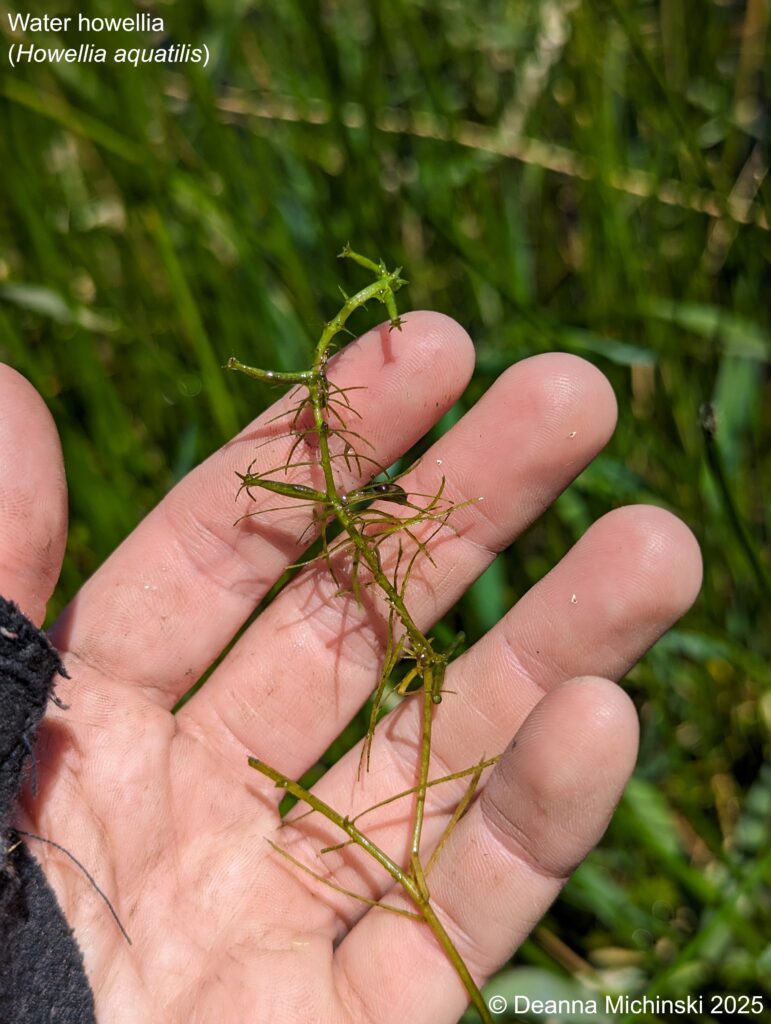
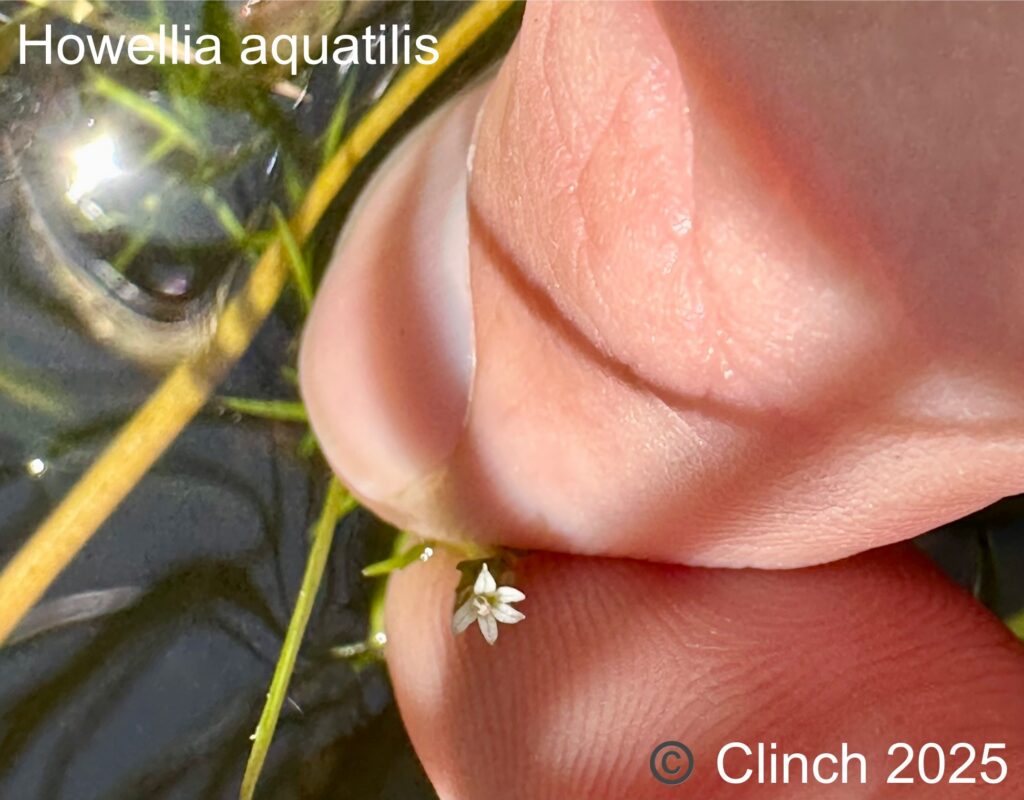
“Is this Water Howellia,” Deanna asked, holding up stringy bits of pondweed that she had pulled from a mucky pool of water in the middle of a cattle pasture. It was an unusually warm day in late May, and most of the vegetation nearby was non-native grasses with some sedges and rushes mixed in. Water Howellia was not a species we anticipated finding.
With the scientific name of Howellia aquatilis, one can surmise it inhabits ‘aquatic’ habitats. The genus, Howellia, is monotypic, meaning there is only one species within the genus, and was named after the brothers Thomas and Joseph Howell, early Oregon botanists who first “discovered” the plant on Sauvie Island in 1878. More collections of Water Howellia were made from Sauvie Island, Lake Oswego, and Salem, by different botanists over the next thirty years. Its habitat was generally described as “stagnant ponds in the timber”. Then nearly 75 years went by without it being seen, and it was thought to be extirpated from the state.
“There’s no way,” I sputtered in response to Deanna’s question, even though my brain was saying “YES!”
I had seen Water Howellia before, in vastly different habitats than where we were on this day. After it was “rediscovered” in 2013 at Metro’s Peach Cove Fen, I visited the natural area in West Linn. There, the fen occupies a depression within bedrock scoured out by the Missoula Floods. Fens are wetlands fed by groundwater and precipitation, and Peach Cove Fen has a floating peat mat that rises and falls with the water level. Water Howellia was generally found around the shaded, shallow edges of the fen and in nearby wetland ponds. Some describe these geologic features as “kolk ponds”; “kolk” meaning “underwater vortex created by water rushing rapidly by an obstacle”.
Filled with enamor for this plant, I volunteered to monitor the known population at Ridgefield National Wildlife Refuge.
At Columbia Stock Ranch, after settling into the realization that Deanna had indeed found this rare species, we celebrated and surveyed the rest of the wetland to document the full extent of the population. We found more Water Howellia co-mingling with other aquatic and emergent vegetation.
Subsequent visits to Columbia Stock Ranch didn’t turn up additional Water Howellia, although more potential habitat is present. The warm, dry spell in late May and early June 2025 accelerated the growing season and dried things up quickly. Water in the wetland where we originally found the Water Howellia had dropped from a depth of about 16 inches to a scant few inches.
As exciting as it was to discover a second known extant population in Oregon, the realization that Water Howellia may tolerate a broader category of habitats than just Missoula Flood-related kolks was equally interesting.
ABOUT WATER HOWELLIA
Plant Anatomy
Water Howellia is in the Bellflower family (campanulaceae) but lacks the broad bell-shaped flowers the family is named for. It more closely resembles species found in the Lobelioideae subfamily of Campanulaceae (formerly Lobeliaceae). Water Howellia has two types of flowers; submerged, cleistogamous (self-pollinating) flowers, and emergent, chasogamous (cross-pollinating) flowers.
Vegetatively, Water Howellia is similar to other aquatic species it sometimes occurs with, particularly Potamogeton (pond weed) and Callitriche (water starwort) species. Its leaves are typically arranged alternately along the stem, arising from a fibrous root system.
Habitat and Life Cycle
It usually floats in or on top of the water column. As water recedes, Water Howellia begins to decompose, making it harder to identify except for its distinguishing fruits. Eventually, even these disintegrate and release their tiny seeds.
As an annual, Water Howellia seeds typically germinate in late fall or early winter on bare ground that will eventually become inundated. Seedlings over-winter underwater and mature into fertile plants by late spring as water warms and precipitation slows. Depending on weather conditions, and how fast the water recedes, Water Howellia can be found blooming generally in May and June, but sometimes as late as August.